
Brazilian Rare Earth & Uranium Projects
CORE’s Brazilian Rare Earth & Uranium projects cover a combined area of ~1,200km² of prospective ground across Bahia, Paraiba, Parana, Goiás and Rio Grande do Sul, Brazil.
CORE has acquired high-quality projects and continues to assess additional areas of high geological potential within Brazil.
CORE’S experienced, Brazil based geologist and in-country team are conducting robust exploration activities across the CORE Brazilian Project portfolio, driving a strong and focused exploration strategy in the top-tier mining jurisdiction of Brazil.
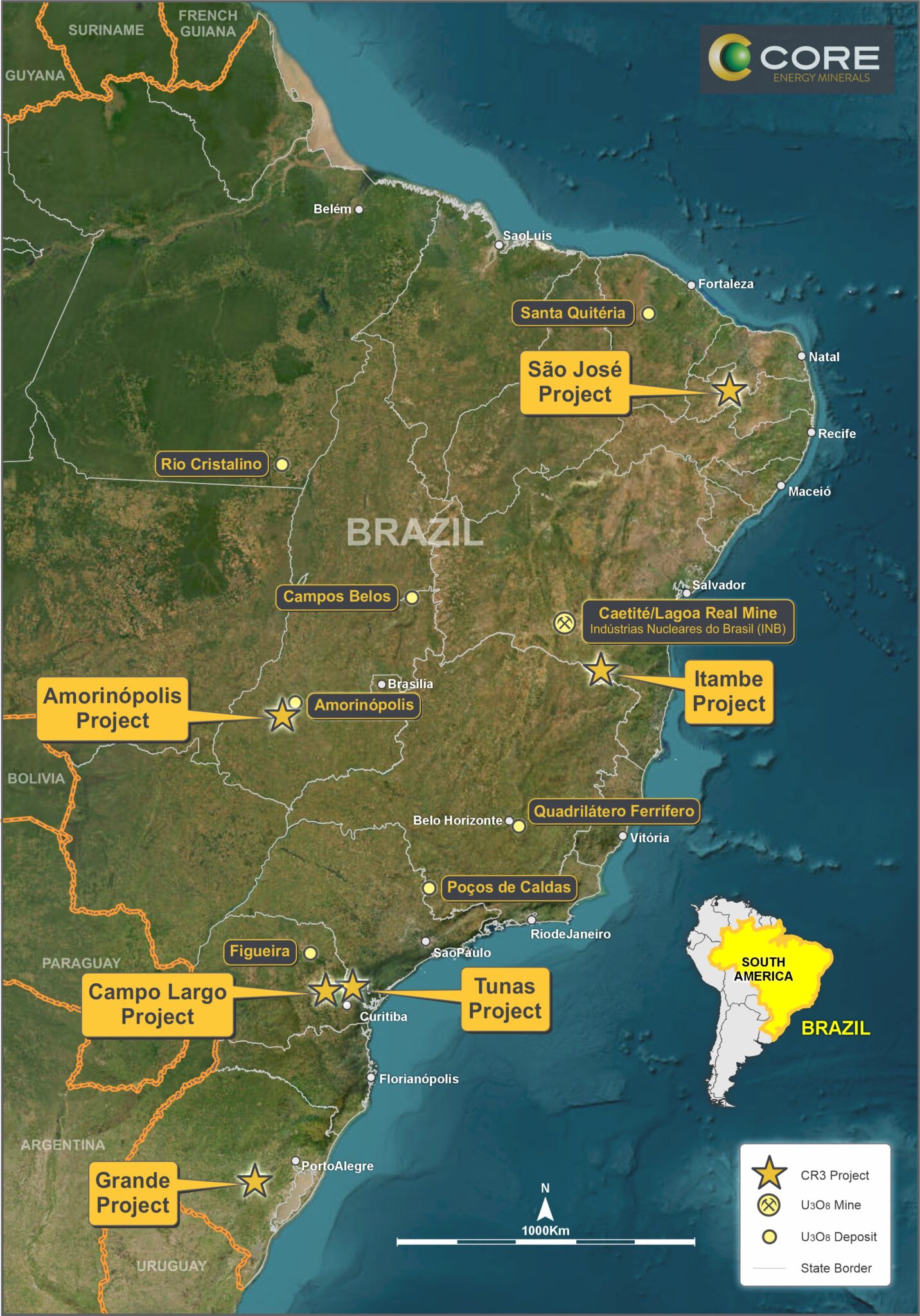
Itambe Rare Earth Element Project – Bahia State
- District scale REE opportunity with 32,791 hectares (327km2) of tenure located in Bahia State, Brazil comprising 23 tenements, where CORE has considerable experience and operational expertise and an existing on-ground geological team
- Located in a highly prospective Rocha da Rocha Rare Earth Province, Bahia State, host to both world class hard rock and ionic rare earth projects such as the exciting Sulista discovery by Brazilian Rare Earths (ASX:BRE)
- Peak soil assays of 5,123ppm Total Rare Earth Oxide in residual soils and importantly consecutive anomalous samples over significant areas
- CORE’s systematic exploration program is underway, consisting of detailed geological and structural mapping, surface geochemical sampling, airborne geophysical surveys (magnetics/ gravity/ radiometric), followed by systematic auger drilling
Tunas Rare Earth Elements Project – Parana
- CORE’S Tunas Project tenure surrounds the largest alkaline intrusive complex in Southern Brazil and covers an area of 18.32km2
- Field operations with a program of stakeholder engagement followed by mapping and reconnaissance sampling have been completed with airborne radiometric data showing strong thorium > uranium – potassium, signature typically favourable for REE deposits
- Significant REE in preliminary soil results: Total Rate Earth Oxide (REO) assay results of 2,921ppm
- Systematic auger soil sampling program underway to define drilling targets
Campo Largo Rare Earth Elements Project – Parana
- Located 60km to the southeast of the Tunas Project, close to logistical infrastructure. The area is interpreted to host intrusive rocks with lithological and geochemical characteristics comparable to those identified at Tunas. These intrusive systems are associated with elevated uranium, thorium and potassium (U–Th–K) signatures and may host well-developed weathering profiles with potential enrichment in REE.
- Early-stage exploration activities at Campo Largo include regional geological reconnaissance mapping and rock sampling across the tenement package, aimed at providing a first-pass assessment of the geological setting and REE prospectivity of the area.
Amorinopolis Uranium Project – Goiás State
- CORE holds 17 contiguous licenses encompassing an area of 320km2. The Amorinópolis Project is prospective for sedimentary hosted uranium mineralisation, as the regional geology consists mostly of a prospective sandstone unit. This unit hosts a historic uranium occurrence identified by INB, which lies to the northwest of CORE’s tenure.
Sao Jose Uranium Project – Paraiba State
- The São José Project is located near the town of São José de Espinharas in Paraiba state. The project consists of 11 licences, which are located over Precambrian gneisses and schists associated with intrusive granites that had been altered by metasomatic processes. The São José Project is uniquely prospective for additional uranium mineralisation, as the current ground consists mostly of granitic lithologies, which are known to be primary host rock for uranium mineralisation within the region.
Grande Uranium Project – Rio Grande do Sul
The Grande Project covers a total of 364.52km2 and is located in the Brazilian state of Rio Grande do Sul and consists of two distinct areas, separated by 4km. Grande is prospective for sandstone and conglomerate hosted uranium deposits, as it is within 4km of a uranium occurrence identified by the INB in the northern part. CORE is targeting an extension of the same lithology (Rio Bonita and Sanga do Cabral Formation) which hosts this occurrence.